Table Of Content

The Integrated Guided Missile Development Programme (IGMDP) is an Indian Ministry of Defence programme for the research and development of a comprehensive range of missiles to strengthen India’s air defence system. This programme was managed and run by DRDO and Ordnance Factory Board (OFB). This programme was run until 2008 from the year 1982 under the leadership of APJ Abdul Kalam. The goal of this programme was to develop strategic missiles, which was achieved by 2008. One of the most successful of the German rockets was the 50-millimetre R4M. The tail fins remained folded until launch, facilitating close loading arrangements.
Fact Sheet: Ballistic vs. Cruise Missiles
Using a steel motor with a tapered nozzle, he achieved greatly improved thrust and efficiency. During World War I Goddard developed a number of designs of small military rockets to be launched from a lightweight hand launcher. By switching from black powder to double-base powder (40 percent nitroglycerin, 60 percent nitrocellulose), a far more potent propulsion charge was obtained.
Third Generation Of Computer With Examples (Simple Terms)
How Did Israel Intercept 99% Of Iran's Drones And Missiles? - ایران اینترنشنال
How Did Israel Intercept 99% Of Iran's Drones And Missiles?.
Posted: Mon, 15 Apr 2024 10:13:39 GMT [source]
Ballistic missiles, on the other hand, are unguided, rocket-powered weapons that follow a high, arching trajectory before descending toward their target. They are typically much faster and have longer ranges, but they lack the in-flight manoeuvrability of cruise missiles, making them more suitable for long-range and strategic strikes. Long- and medium-range ballistic missiles are generally designed to deliver nuclear weapons because their payload is too limited for conventional explosives to be cost-effective in comparison to conventional bomber aircraft. A missile is one of the most important technological advanced projectile which is used for various purpose like scientific, military and space exploration.
Quasi-ballistic missiles
Army when the Armistice was signed; they became the forerunners of the bazooka of World War II. We frequently notice news related to ballistic missiles, cruise missiles and various missile systems of India. Memorizing names and salient features of various Indian missiles is hard without having a broader understanding of the concept of ballistic missiles and cruise missiles, and major missile defence systems. It is better to give these concepts a holistic structure rather than learning them in bits and pieces. They usually are composed of a solid rocket booster stage lifting a warhead and guidance section aloft as a payload .
Ballistic Missile vs. Cruise Missile, India’s Missile Systems, IGMDP
The new rocket, about 20 inches (50 centimetres) long, 2.36 inches in diameter, and weighing 3.5 pounds, was fired from a steel tube that became popularly known as the bazooka. Designed chiefly for use against tanks and fortified positions at short ranges (up to 600 yards), the bazooka surprised the Germans when it was first used in the North African landings of 1942. Although the rocket traveled slowly, it carried a potent shaped-charge warhead that gave infantrymen the striking power of light artillery. First, he experimented with a number of black-powder formulas and set down standard specifications of composition.

The Simple Difference Between Ballistic Missiles and Cruise Missiles
We will look at the performs which differentiate the two types of Missiles. A BCA graduate, Web developer, Technophile and a reading enthusiast who likes to research and explore. Now professionally utilising my technical skills in blogging to create information and engaging content. We determine unique page counts by using a “hashed” version of the visitor’s IP address. The visitor’s full IP address is deleted from our logs after a little over a month. That timeframe is how long the data is needed in order to allow us to calculate your stats on a monthly basis and no longer.
Although the concept was proven sound and the 500-megawatt engine finished a successful test run in 1961, no airworthy device was ever completed. The Soviet Union and the United States built unguided ballistic rockets for about 30 years after the war. Army began deployment of the Honest John in western Europe, and from 1957 the Soviet Union built a series of large, spin-stabilized rockets, launched from mobile transporters, given the NATO designation FROG (free rocket over ground). These missiles, from 25 to 30 feet long and two to three feet in diameter, had ranges of 20 to 45 miles and could be nuclear-armed. Both of those Vergeltungswaffen, or “Vengeance Weapons,” defined the problems of propulsion and guidance that have continued ever since to shape cruise and ballistic missile development.
Most other countries pursuing missile technology have not developed strategic weapons to the extent of the United States and the former Soviet Union. Nonetheless, several other countries have produced them; among these are the United Kingdom, France, China, Pakistan, Israel, Iran, South Korea, and North Korea. Also, as with any technology, there has occurred a transfer of ballistic missile technology to less-developed countries. Combined with the widespread capacity to produce chemical warheads, such weapons represent a potent addition to the arsenals of emerging powers of the developing world. At the conference held by CSIS, the threat from cruise missiles was discussed as a way that other countries could attack the United States that is hard to detect by employing existing, ICBM-focused measures.
Strategic missiles usually carry nuclear warheads, while tactical missiles usually carry high explosives. Cruise missiles are unmanned vehicles that are propelled by jet engines, much like an airplane. Cruise missiles remain within the atmosphere for the duration of their flight and can fly as low as a few meters off the ground. Flying low to the surface of the earth expends more fuel but makes a cruise missile very difficult to detect.
A guided missile is broadly any military missile that is capable of being guided or directed to a target after having been launched. Tactical guided missiles are shorter-ranged weapons designed for use in the immediate combat area. Long-range, or strategic, guided missiles are of two types, cruise and ballistic. Cruise missiles are powered by air-breathing engines that provide almost continuous propulsion along a low, level flight path. A ballistic missile is propelled by a rocket engine for only the first part of its flight; for the rest of the flight the unpowered missile follows an arcing trajectory, small adjustments being made by its guidance mechanism.

The Arabs are reported to have used rockets on the Iberian Peninsula in 1249; and in 1288 Valencia was attacked by rockets. In Italy, rockets are said to have been used by the Paduans (1379) and by the Venetians (1380). Here, in this article, we will understand the difference between the Ballistic Missile and the Cruise Missile.
What to know about Shahed-136 drones, which Iran used to attack Israel - The Washington Post
What to know about Shahed-136 drones, which Iran used to attack Israel.
Posted: Tue, 16 Apr 2024 23:08:00 GMT [source]
Many researchers besides Goddard used the wartime interest in rockets to push experimentation, the most noteworthy being Elmer Sperry and his son, Lawrence, in the United States. The Sperrys worked on a concept of an “aerial torpedo,” a pilotless airplane, carrying an explosive charge, that would utilize gyroscopic, automatic control to fly to a preselected target. Army Signal Corps organized a separate program under Charles F. Kettering in Dayton, Ohio, late in 1918. The Kettering design used a gyroscope for lateral control to a preset direction and an aneroid barometer for pitch (fore and aft) control to maintain a preset altitude. A high angle of dihedral (upward tilt) in the biplane wings provided stability about the roll axis.
Most U.S. systems carried warheads of less than one megaton, with the largest being the nine-megaton Titan II, in service from 1963 through 1987. The Soviet warheads often exceeded five megatons, with the largest being a 20- to 25-megaton warhead deployed on the SS-7 Saddler from 1961 to 1980 and a 25-megaton warhead on the SS-9 Scarp, deployed from 1967 to 1982. Strategic missile, jet- or rocket-propelled weapon designed to strike targets far beyond the battle area. Cruise missiles are jet-propelled at subsonic speeds throughout their flights, while ballistic missiles are rocket-powered only in the initial (boost) phase of flight, after which they follow an arcing trajectory to the target.
The V-1, often called a flying bomb, contained a gyroscope guidance system and was propelled by a simple pulsejet engine, the sound of which gave it the nickname of "buzz bomb" or "doodlebug". Accuracy was sufficient only for use against very large targets (the general area of a city), while the range of 250 km was significantly lower than that of a bomber carrying the same payload. The main advantages were speed (although not sufficient to outperform contemporary propeller-driven interceptors) and expendability. Bomber-launched variants of the V-1 saw limited operational service near the end of the war, with the pioneering V-1's design reverse-engineered by the Americans as the Republic-Ford JB-2 cruise missile.
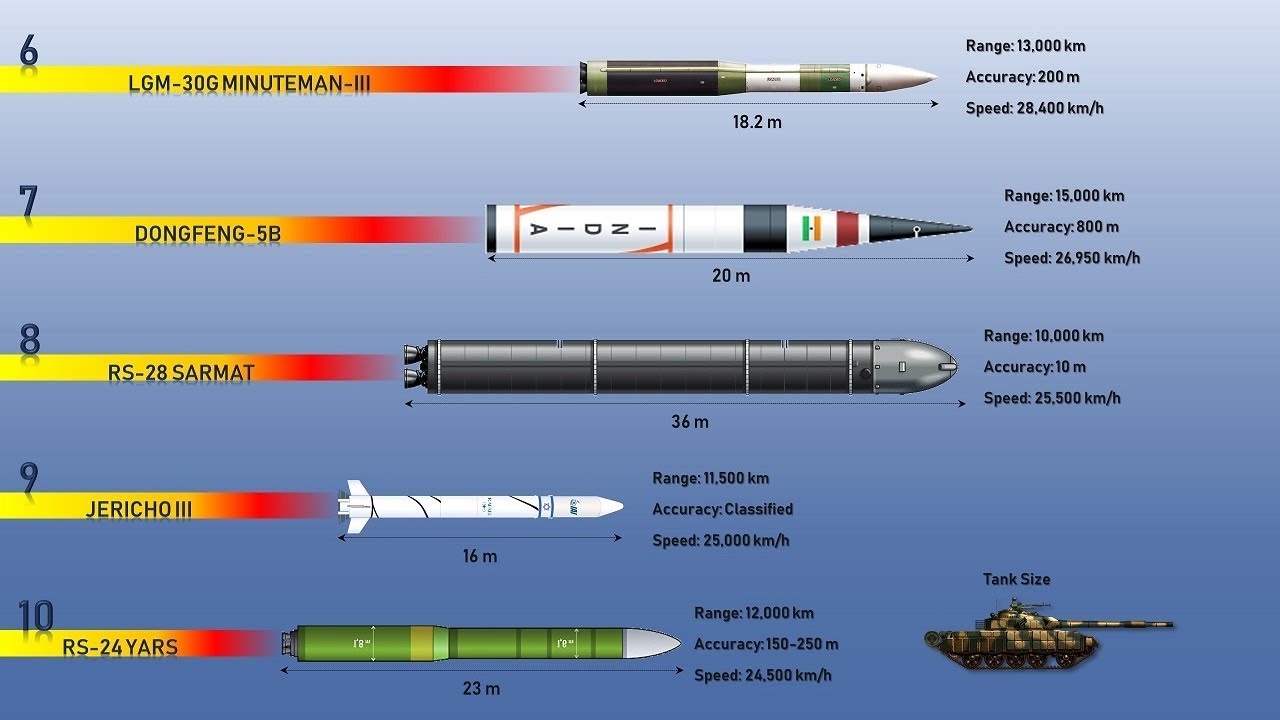
Ballistic missiles are guided during brief periods of their flight, aerodynamically and/or by thrust vectoring. Intercontinental Ballistic missiles go into a suborbital paths and spend a considerable part of their trajectory outside the atmosphere. Any missile is called Ballistic when the trajectory it follows is ballistic. Ballistic missiles are unguided, high-speed, long-range, and follow a high trajectory. Throw-weight is normally calculated using an optimal ballistic trajectory from one point on the surface of the Earth to another.
These rockets were highly effective against motor columns, tanks, troop and supply trains, fuel and ammunition depots, airfields, and barges. World War I actually saw little use of rocket weapons, despite successful French incendiary antiballoon rockets and a German trench-war technique by which a grappling hook was thrown over enemy barbed wire by a rocket with a line attached. There are no details of the construction of these rockets, but they were presumably quite crude. The tubular rocket cases were probably many layers of tightly wrapped paper, coated with shellac. The propulsive charge was the basic black powder mixture of finely ground carbon (charcoal), potassium nitrate (saltpetre), and sulfur. The English scientist Roger Bacon wrote formulas for black powder about 1248 in his Epistola.